A poison tree tattoo looks like a dark, twisted tree. Its meaning is much deeper than its look. It stands for anger that was never spoken, and for what happens when that anger is left to grow.
If you’ve seen this design on a friend’s arm, or you’re thinking about getting one, this guide covers everything. You’ll learn where the symbol comes from, what each visual detail means, and who tends to choose it. You’ll also get placement ideas and mistakes to avoid.
What Does a Poison Tree Tattoo Mean?
A poison tree tattoo symbolizes suppressed anger, hidden resentment, and the damage caused by unspoken feelings. It shows what happens when you bottle up pain instead of dealing with it.
Poison tree tattoo meaning in simple terms: silence feeds anger, and anger left alone grows into something harmful.
Most wearers read it in one of three ways:
- As a warning: “Don’t let bitterness grow in me.”
- As a memory: “This is what betrayal did to me.”
- As proof of healing: “I faced it, and I moved on.”
Where Does the Poison Tree Symbol Come From?
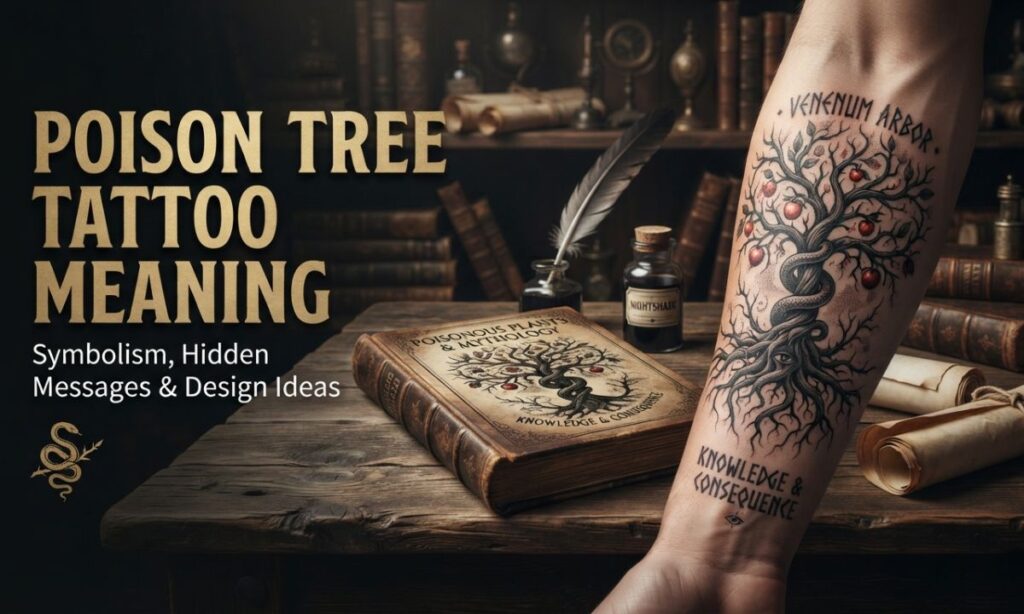
The symbol has two main roots. One is a famous poem, and the other is much older religious and folk imagery.
✍️ The William Blake Poem: A Quick Breakdown
The tattoo comes from A Poison Tree by English poet William Blake. It was published in 1794 in his collection Songs of Experience. Blake’s own notebook draft carried a different title, “Christian Forbearance.”
The poem is only four short stanzas. Here is the story in plain words:
- The speaker is angry with a friend, says so, and the anger ends.
- The speaker is angry with an enemy, says nothing, and the anger grows.
- He feeds it with fear, tears, and fake smiles, and it grows into a shiny apple.
- The enemy sees the apple, steals into the garden, and dies under the tree.
The lesson is simple. Spoken anger fades, and hidden anger becomes a weapon. Many readers also note that the speaker is damaged by his own deceit. That double edge is why the tattoo appeals to people who know how resentment can eat at the person carrying it.
Biblical and Historical Roots of the Poison Tree
Poison tree tattoo meaning in the Bible: the poem is not scripture, but it echoes several biblical images.
- The Tree of Knowledge (Genesis 2–3): a tempting fruit that leads to a fall. Blake’s glowing apple recalls it directly.
- “Root of bitterness” (Hebrews 12:15): bitterness that grows and spreads harm.
- Bitter roots (Deuteronomy 29:18): a warning about a root that produces poison.
- Good and bad fruit (Matthew 7:17–18): a corrupt tree produces corrupt fruit.
- Letting anger linger (Ephesians 4:26): advice not to let anger sit overnight.
There is a historical layer too. In Blake’s era, Europeans told tales of the upas tree, a legendary Javanese tree said to kill anything nearby. Real trees like the manchineel also have earned nicknames like “tree of death.” These stories give the poison tree its visual power.
What Emotions Does a Poison Tree Tattoo Represent?
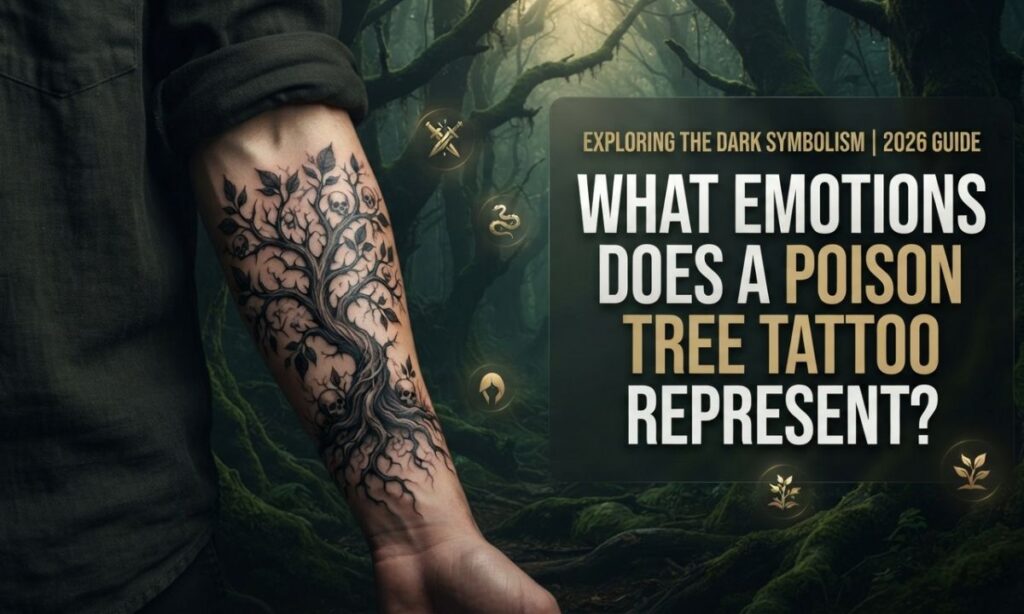
The design covers a wide emotional range. Common meanings include:
- Suppressed anger: feelings you never got to express
- Betrayal: broken trust from a partner, friend, or relative
- Resentment: grudges that grew over time
- Inner conflict: the gap between how you feel and how you appear
- Self-awareness: admitting your own shadow side
- Caution: a reminder to set boundaries
- Transformation: growth after surviving emotional darkness
- Revenge or its rejection: the pull toward payback, or the choice to let it go
Poison Tree Tattoo Designs: What the Visual Elements Mean
Every detail in the artwork adds a layer. Here’s how to read (or plan) them.
| Design Element | Symbolic Meaning |
| Bare, twisted branches | Emotional strain, inner turmoil |
| Exposed roots | Old wounds, the source of the anger |
| A single glowing apple or fruit | Temptation, revenge, the cost of unchecked wrath |
| Thorns or dripping sap | Pain, toxicity, self-protection |
| A snake coiled on the trunk | Betrayal, deception, temptation |
| Crow or raven | Grief, warnings, hard truths |
| Skull or body beneath the tree | Consequences (echoes Blake’s original illustration) |
| Moon or night sky | Secrecy, hidden feelings |
| New leaves on one branch | Healing and recovery |
Popular styles:
- Blackwork: bold, high-contrast, and dramatic
- Fine line: delicate and minimal, good for smaller pieces
- Dotwork: moody texture with a softer feel
- Illustrative or engraving style: a nod to Blake’s own printmaking
- Realism: detailed bark, roots, and fruit
Who Gets Poison Tree Tattoos and Why?
There is no single type of wearer. Still, a few groups come up often.
Survivors of toxic relationships. The tree marks an ending, and the lesson that came with it.
Readers and literature fans. People who love Blake or English literature often choose it as a quiet nod to the poem.
People working on anger or emotional honesty. It acts as a daily reminder to speak up early.
Poison Tree Tattoo Meaning for Men and Guys
The meaning is the same for everyone. Men often choose it to show emotional restraint, or as a reminder to stop swallowing their feelings. Designs tend to run larger and darker, such as blackwork sleeves or realistic bark.
Poison Tree Tattoo Meaning for Women and Girls
Women often pair the tree with softer details like flowers, fine-line branches, or a small fruit. The meaning tends to focus on betrayal, boundaries, and reclaiming peace. These are style trends, not rules.
Poison Tree Tattoo Meaning in the Family Context
For some, the tree stands for family wounds: unresolved conflict, estrangement, or patterns passed down through generations. It can mark the choice to break that cycle.
Poison Tree Tattoo vs. Other Dark Tree Tattoos: Key Differences
Dark tree tattoos often get mixed up. Here’s how they compare.
| Tattoo | Core Meaning | Mood | Best For |
| Poison Tree | Suppressed anger, resentment, consequences | Intense, reflective | People processing betrayal or anger |
| Dead Tree | Loss, endings, mortality | Somber | Grief and remembrance |
| Tree of Life | Growth, family, connection | Hopeful | Celebrating roots and legacy |
| Weeping Willow | Sorrow, mourning, letting go | Gentle, sad | Honoring someone lost |
| Gnarled Oak | Endurance, strength | Strong | Resilience after hardship |
The key difference: a dead tree shows something that has ended. A poison tree shows something still active and dangerous until it’s dealt with.
Placement Ideas and What They Add to the Meaning
Where you place the tattoo changes how it reads and who sees it.
| Placement | What It Adds |
| Forearm | Visible and personal, a daily reminder. Great for vertical trees. |
| Upper arm or sleeve | Room for roots, fruit, and background detail |
| Back | A large, private canvas. Suggests burdens carried behind you. |
| Ribs or chest | Close to the heart, tied to emotional pain |
| Calf or thigh | Good for tall, flowing branches |
| Wrist or hand | Small and minimal, but detail can blur over time |
Poison tree tattoo meaning on the forearm: because you see it often, it works as a self-reminder to speak up, set boundaries, and let go.
Common Mistakes People Make With This Tattoo
- Reading it as a celebration of revenge. Blake’s poem is a warning, not an endorsement.
- Skipping the research. Others may ask about it, and knowing the poem helps.
- Cramming in too much detail at a small size. Fine lines can blur as skin ages.
- Getting inked in the heat of a breakup. Give strong emotions time to settle first.
- Misquoting the poem. If you add text, check spelling and line breaks carefully.
- Ignoring placement and visibility. Think about work, family, and how you’ll feel about it in ten years.
- Choosing an artist by price. Find one experienced in blackwork or fine-line botanical work.
Does the Poison Tree Tattoo Have a Positive Meaning?
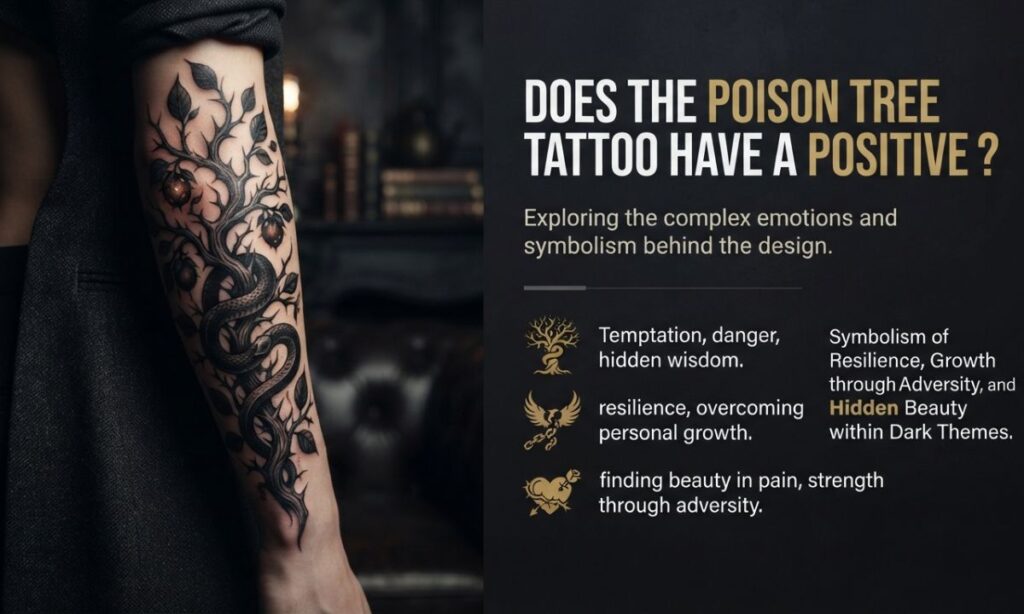
Yes, for many wearers it does. The darkness is only half the story.
The tattoo can mean awareness: you know what unspoken anger does. It can mean honesty: you choose to talk early. And it can mean healing: you survived the thing that grew the tree. A poison tree can be a scar, and a scar shows you got through it.
Related Keywords Worth Knowing
Searches often touch these related ideas:
- Poison tree symbolism
- William Blake tattoo ideas
- Suppressed anger tattoo
- Betrayal tattoo meaning
- Dark tree tattoo designs
- Forbidden fruit tattoo
- Blackwork tree tattoo
- Fine line tree tattoo
- Tattoos about emotional healing
Frequently Asked Questions
What is the poison tree tattoo meaning?
It stands for suppressed anger and hidden resentment that grow harmful when left unspoken, based on William Blake’s 1794 poem.
What is the poison tree tattoo meaning in simple terms?
It means unspoken anger doesn’t disappear. It grows and eventually hurts you or others.
What is the poison tree tattoo meaning in the Bible?
The poem isn’t in the Bible, but it echoes Eden’s forbidden tree and the “root of bitterness” passage in Hebrews 12:15.
What is the poison tree tattoo meaning on Urban Dictionary?
I couldn’t find an established slang definition. The commonly accepted meaning comes from Blake’s poem, so treat user-submitted slang entries with caution.
What is the poison tree tattoo meaning on X?
The meaning doesn’t change on social media. Posts on X (Twitter) mostly share designs and personal stories tied to anger, betrayal, or healing.
What is the poison tree tattoo meaning for men and guys?
It often symbolizes bottled-up emotion and the importance of speaking up. Designs skew toward bold blackwork.
What is the poison tree tattoo meaning for women and girls?
It commonly reflects betrayal, boundaries, and healing, often in softer, fine-line styles.
What is the poison tree tattoo meaning for family?
It can represent family conflict, estrangement, or a decision to break a cycle of resentment.
What does a poison tree tattoo mean on the forearm?
A forearm placement keeps the reminder visible, making it a daily nudge toward honest communication.
Conclusion
The poison tree tattoo is more than a moody image. It carries a clear message from a 230-year-old poem: unspoken anger grows, and it rarely stays harmless. Whether you see it as a warning, a scar, or a sign of healing, its meaning is deeply personal.
Before you book a session, decide what the tree means to you. Then pick the elements, style, and placement that tell that story. Take time to find an artist who can bring it to life.
